

Headquarters
7150 Columbia Gateway Drive, Suite L, Columbia, MD 21046
New York Location
112 West 34th Street, 18th floor, Room 18025 New York, NY 10001
Proud Member


Eco-Friendly & Interactive: How Touch Screen Solutions Are Powering Portland's Green Business Movement4 minute read | Updated June 19, 2026
Portland doesn't just talk about sustainability. It builds it into zoning codes, business licensing requirements, municipal procurement policies, and the cultural expectations that shape how companies operate and how consumers choose where to spend their money. In a city that has consistently ranked among the top five most sustainable cities in the United States — and in a region where the green economy is not a niche but a mainstream business imperative — environmental responsibility is as much a competitive differentiator as price, product quality, or customer experience. For businesses operating in Portland, Seattle, and across the broader Pacific Northwest, that reality creates both a responsibility and an opportunity. The responsibility is clear: operations, supply chains, and physical environments should reflect a genuine commitment to reducing waste, minimizing energy consumption, and supporting the region's ambitious carbon reduction goals. The opportunity is equally clear: businesses that can demonstrate authentic, measurable environmental leadership earn the trust, loyalty, and advocacy of a consumer base that takes these issues seriously and rewards the companies that do the same. Interactive touch screen technology sits at an increasingly interesting intersection of those two forces. For the businesses replacing paper menus, static posters, printed wayfinding materials, and disposable promotional collateral with energy-efficient digital display systems, the environmental case is real and quantifiable. And for the customers, tenants, patients, and visitors who interact with those displays, the signal is unmistakable: this is a business that has thought carefully about its footprint and made a choice that reflects its values.
The Hidden Environmental Cost of Paper-Based CommunicationBefore examining what interactive display technology delivers, it's worth taking an honest look at what it replaces — because the environmental cost of paper-based business communication is routinely underestimated. The average full-service restaurant in the United States goes through approximately 2,000 to 4,000 paper menus per year when accounting for reprinting driven by seasonal menu changes, pricing updates, damage, and general wear.⁷ For a Portland restaurant group operating five locations, that's potentially 20,000 menus annually — before accounting for the promotional inserts, table cards, specials boards, and takeout materials that accompany them. Each menu requires paper production, printing, and ultimately disposal, often in non-recyclable laminated formats. Scale this across the full spectrum of paper-based business communication — the retail price tags and promotional signage reprinted with every seasonal reset, the corporate office directories and floor maps reprinted with every organizational change, the hotel amenity guides reprinted with every policy update, the hospital wayfinding materials reprinted with every department relocation — and the cumulative environmental impact becomes substantial. The Environmental Paper Network estimates that the United States consumes approximately 68 million tons of paper annually, with commercial printing and business communication materials representing a significant share of that total.¹ Paper production is among the most resource-intensive manufacturing processes: it is the third largest industrial polluter in the United States, a major consumer of freshwater resources, and a significant contributor to deforestation when not sourced from certified sustainable forestry operations.² For Portland and Seattle businesses that have made supply chain sustainability a priority — sourcing local ingredients, choosing certified sustainable materials, auditing vendor environmental practices — the paper footprint of their own communications infrastructure is often an overlooked area of meaningful impact. Interactive display technology addresses it directly.
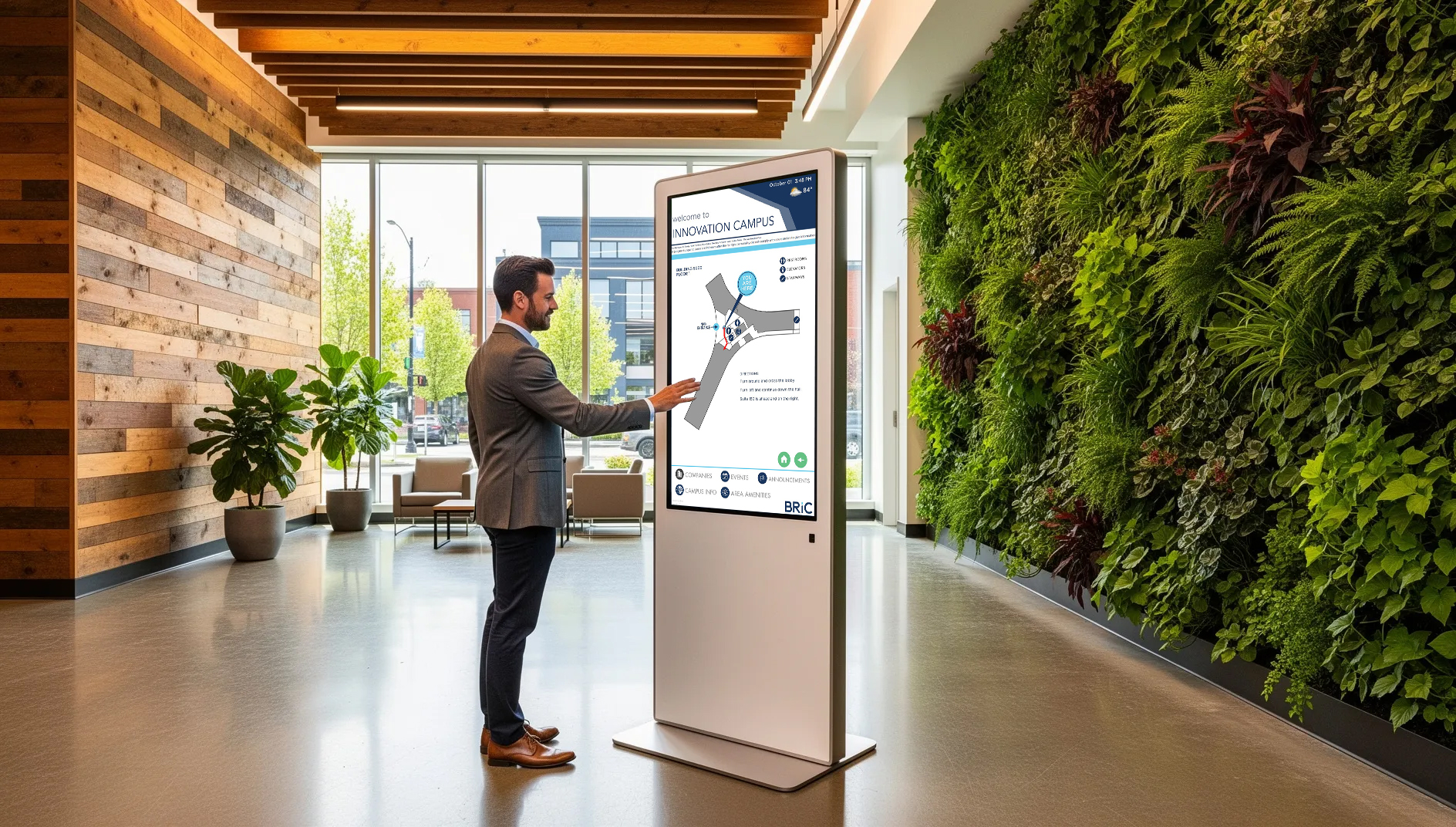
Energy-Efficient Hardware: The ITS DifferenceThe environmental case for digital displays rests substantially on the energy efficiency of the hardware — and this is where the quality of the technology partner matters enormously. Not all display systems are created equal, and the gap between a well-engineered, energy-efficient interactive kiosk and a lower-specification alternative can be significant in terms of both power consumption and lifecycle environmental impact. Energy Star certification is the benchmark standard for commercial display hardware energy efficiency, established by the U.S. Environmental Protection Agency and the Department of Energy. Energy Star certified displays meet strict power consumption thresholds — typically consuming 25–30% less energy than non-certified equivalents — and are tested for performance across a range of operational conditions to ensure that energy efficiency doesn't come at the cost of display quality or reliability.³ For businesses in Portland and Seattle that are tracking their energy consumption as part of carbon reduction commitments, building sustainability certifications, or utility efficiency programs, deploying Energy Star certified interactive displays has a direct and measurable impact on their energy footprint. And for businesses operating in Oregon and Washington — both of which have committed to aggressive grid decarbonization timelines — the energy consumed by commercial equipment is increasingly drawn from renewable sources, further amplifying the environmental benefit of efficient hardware. Beyond energy consumption during operation, the lifecycle environmental impact of display hardware is shaped by durability, repairability, and end-of-life materials handling. Higher-quality display systems are designed to last longer — reducing the frequency of hardware replacement and the associated manufacturing and disposal impacts. ITS, Inc. specifies hardware built to commercial-grade durability standards, with service and support infrastructure designed to extend operational lifespans and minimize unnecessary replacement cycles.
LEED, Living Building Challenge, and the Green Building EcosystemPortland and Seattle are among the leading cities in North America for green building certification — and the commercial real estate developments where interactive display technology is increasingly deployed are often operating within a sustainability certification framework that directly rewards energy-efficient technology choices. The U.S. Green Building Council's LEED (Leadership in Energy and Environmental Design) rating system is the most widely adopted green building standard globally, and both Portland and Seattle have significant concentrations of LEED-certified commercial, mixed-use, and institutional buildings. The Living Building Challenge — an even more rigorous standard developed by the International Living Future Institute, which is headquartered in Seattle — has also taken strong root in the region, with several landmark projects pursuing its demanding net-zero and net-positive energy requirements. Within these certification frameworks, the energy consumption and environmental sourcing of installed equipment — including display systems and interactive kiosks — can contribute to certification points and compliance with specific credit requirements. LEED v4's Energy and Atmosphere credits, for example, reward buildings that deploy Energy Star certified equipment and that demonstrate ongoing energy performance monitoring. For a property developer or building operator pursuing LEED Gold or Platinum certification for a mixed-use development in Portland's Pearl District or Seattle's South Lake Union, the choice of interactive display technology is not a peripheral concern — it's part of the certification calculus. The U.S. Green Building Council reports that LEED-certified buildings consume an average of 25% less energy and 11% less water than non-certified equivalents, and that tenant and occupant satisfaction scores in certified buildings are consistently higher.⁴ For property managers who are both pursuing certification and competing for premium tenants who prioritize sustainability, every equipment choice — including interactive displays — is an opportunity to reinforce the building's green credentials.
Reducing the Corporate Carbon Footprint: A Measurable ImpactFor Portland and Seattle businesses that have established formal carbon reduction commitments — whether as part of a Science Based Targets initiative (SBTi) pledge, a B Corporation certification requirement, or a voluntary corporate sustainability program — the transition from paper-based to digital communications infrastructure represents a concrete, reportable reduction in Scope 3 emissions. Scope 3 emissions — the indirect emissions associated with a company's value chain, including the production and disposal of purchased materials — are increasingly the focus of corporate sustainability reporting, as they typically represent the largest share of a business's total carbon footprint. The paper consumed in menus, signage, promotional materials, and wayfinding collateral generates emissions at every stage: timber harvesting and transportation, pulp and paper manufacturing, printing and finishing, distribution, and end-of-life disposal (particularly for non-recyclable laminated materials that end up in landfill rather than the recycling stream). Replacing these materials with a digital display system generates a different, and typically much smaller, emissions profile — primarily associated with hardware manufacturing, operational energy consumption, and eventual end-of-life recycling. When the comparison is made across a five-to-ten year operational horizon, the net emissions reduction from transitioning paper-based communications to interactive digital displays is substantial and documentable. The Carbon Disclosure Project (CDP) has noted that businesses with formal Scope 3 reduction programs consistently identify materials and consumables substitution — replacing high-impact physical materials with lower-impact digital alternatives — as among the most accessible and cost-effective levers available to them.⁵ For a Portland restaurant group, a Seattle retail brand, or a Pacific Northwest healthcare system with established sustainability commitments, the transition to interactive display technology is a natural fit within that framework.
The Practical Sustainability Story for Key Pacific Northwest SectorsThe environmental benefits of interactive display technology play out differently across sectors — and it's worth examining how the sustainability case lands in the specific business contexts where ITS, Inc. works most closely with Pacific Northwest clients. Restaurants and Hospitality Portland's food and beverage scene is among the most sustainability-conscious in the country. Restaurants that have invested in local sourcing, composting programs, sustainable packaging, and energy-efficient kitchen equipment are increasingly looking at the paper footprint of their menus and promotional materials as the next area of focus. Digital menu boards and table-side interactive displays eliminate the reprinting cycle entirely — allowing operators to update pricing, seasonal offerings, and allergen information in real time without generating any physical waste. For a Portland restaurant that reprints menus four times per year across three locations, the elimination of that print cycle alone can represent thousands of dollars in annual savings and a meaningful reduction in paper consumption. Retail Seattle and Portland retailers who have built their brand around environmental values — outdoor apparel brands, natural products retailers, sustainable fashion boutiques — face a particular authenticity challenge when their in-store experience relies on paper-heavy signage, promotional displays, and wayfinding materials. Interactive displays allow these retailers to align their in-store communications infrastructure with the sustainability values their brand communicates externally. The result is an environment that feels coherent — where the materials, the messaging, and the technology all tell the same story. Commercial Real Estate and Mixed-Use Development For CRE developers and property managers operating LEED-certified or sustainability-focused mixed-use developments, the common-area communications environment — directory systems, wayfinding displays, event and amenity information boards — is a high-visibility opportunity to demonstrate the building's green credentials to tenants, visitors, and prospective lessees. Replacing static printed directories and paper-based wayfinding materials with energy-efficient interactive displays reduces ongoing paper consumption, eliminates the operational overhead of maintaining printed materials, and contributes to the building's overall energy and sustainability performance profile. Healthcare Portland and Seattle's major healthcare systems — including those undergoing significant expansion and modernization — operate within an institutional sustainability framework that is increasingly rigorous. The Practice Greenhealth network, which includes many of the Pacific Northwest's leading hospitals and health systems, has established detailed benchmarks for healthcare facility sustainability across energy, water, waste, and materials categories. Interactive wayfinding and patient information systems that replace printed materials contribute directly to healthcare facilities' waste reduction metrics — and do so in a way that simultaneously improves the patient and visitor experience.
The Business Case Beyond Sustainability: Operational and Financial ReturnsThe environmental case for interactive display technology is compelling on its own terms — but for Pacific Northwest business leaders who are balancing sustainability commitments against operational realities and financial performance, the good news is that the environmental and business cases point in the same direction. Elimination of recurring print costs is the most immediate financial benefit. For businesses that regularly update menus, pricing, promotions, wayfinding materials, or informational content, the cost of designing, printing, and distributing physical materials is a recurring overhead expense that digital displays eliminate entirely. For a mid-size hotel group managing amenity guides, event listings, restaurant menus, and local area information across multiple properties, the annual print savings alone can meaningfully offset the investment in digital display infrastructure. Operational agility is the second major financial benefit. The ability to update content across a display network in real time — pushing a new promotion, correcting a pricing error, updating a menu item, reflecting a department relocation — is not just a sustainability win. It's a competitive advantage that allows businesses to respond to market conditions, operational changes, and customer preferences with a speed that paper-based systems structurally cannot match. Tenant and customer attraction is the third. In the Pacific Northwest's commercial real estate and retail markets, sustainability credentials are increasingly a factor in tenant selection, customer loyalty, and brand preference decisions. Nielsen's Global Sustainability Report found that 73% of global consumers say they would definitely or probably change their consumption habits to reduce environmental impact — a figure that is even higher among the Pacific Northwest's educated, values-driven consumer base.⁶ Businesses and properties that can authentically communicate their sustainability investments — including through the visible choice of energy-efficient, paper-replacing interactive technology — earn a meaningful advantage in this environment.
Portland's Green Business Program and the Path to CertificationFor Portland-based businesses specifically, the City of Portland's Green Business Program offers a structured pathway to formal recognition for companies that meet established environmental performance benchmarks across energy, waste, transportation, and materials categories. Interactive display technology that replaces paper-based communications and meets Energy Star efficiency standards can contribute to a business's Green Business Program compliance — and the certification itself carries marketing and reputational value with Portland's sustainability-conscious consumer base. Similarly, Oregon's Department of Energy administers incentive programs for commercial energy efficiency investments that may apply to qualifying interactive display deployments — reducing the net capital cost of transitioning to digital display infrastructure. Washington State's Department of Commerce offers parallel programs for Seattle-area businesses. ITS, Inc. works with clients to identify applicable incentive programs and ensure deployments are structured to meet qualifying criteria.
A Sustainability-Forward Technology Partner: ITS, Inc.At ITS, Inc., we understand that for Pacific Northwest businesses, sustainability isn't a checkbox — it's a core business value that needs to be reflected in every operational decision, including the technology partners they choose. We specify Energy Star certified hardware, design deployments for long operational lifespans that minimize replacement cycles, and support clients in documenting the environmental impact of their display infrastructure for sustainability reporting purposes. We also understand that the sustainability conversation is inseparable from the broader business case — and we bring both lenses to every client engagement. The goal is always a deployment that delivers measurable environmental benefits, strong operational returns, and an enhanced experience for the customers, patients, tenants, and visitors who interact with it every day. Portland and Seattle are building a greener future. ITS, Inc. is proud to be part of that work.
Ready to Align Your Technology with Your Values?ITS, Inc. partners with Portland and Seattle businesses, CRE developers, healthcare systems, and institutional operators to design and deploy interactive touch screen solutions that deliver measurable environmental benefits alongside exceptional operational and guest experience outcomes. If your business is ready to replace paper waste with smart, energy-efficient digital display infrastructure, we're here to help you build the business case, design the right solution, and execute a deployment that reflects your values.
Sources
Frequently Asked QuestionsHow do interactive displays reduce a business's environmental footprint compared to traditional signage? Interactive displays replace the recurring cycle of paper-based communications — menus, promotional signage, wayfinding materials, informational collateral — with a single, updateable digital infrastructure. This eliminates the paper consumption, printing chemicals, transportation, and landfill waste associated with physical materials that must be regularly reprinted and replaced. Over a five-to-ten year operational horizon, the net environmental impact of a well-deployed digital display system is substantially lower than the cumulative impact of the paper-based materials it replaces. What does Energy Star certification mean for commercial display hardware, and why does it matter? Energy Star certification is the EPA and DOE's standard for energy efficiency in commercial equipment. Certified displays consume 25–30% less energy than non-certified equivalents, which translates directly to lower operational energy costs and a smaller carbon footprint. For businesses tracking energy consumption as part of carbon reduction commitments or green building certification programs, deploying Energy Star certified hardware is a concrete, documentable step toward their sustainability targets. Can switching to digital displays help a Portland business qualify for the City's Green Business Program? Yes. The City of Portland's Green Business Program evaluates businesses across multiple environmental performance categories, including materials and waste reduction. Replacing paper-based communications with digital display infrastructure contributes to a business's performance in the materials category, and deploying Energy Star certified hardware contributes to the energy efficiency category. ITS, Inc. can help businesses document these contributions as part of their Green Business Program application. How do interactive displays contribute to LEED certification for commercial buildings? LEED v4's Energy and Atmosphere credits reward buildings that deploy Energy Star certified equipment and demonstrate ongoing energy performance. For property developers and building operators pursuing LEED Gold or Platinum certification, the choice of energy-efficient interactive display systems can contribute to specific credit requirements. ITS, Inc. works closely with green building teams to ensure display deployments are specified and documented in ways that support certification goals. Are there financial incentives available in Oregon or Washington for energy-efficient display technology? Yes. Oregon's Department of Energy and Washington's Department of Commerce both administer commercial energy efficiency incentive programs that may apply to qualifying interactive display deployments. The specific programs, eligibility criteria, and incentive amounts vary and are subject to change. ITS, Inc. works with clients to identify applicable programs and structure deployments to meet qualifying criteria — reducing the net capital investment required. How does ITS, Inc. approach sustainability in its own hardware specifications and deployment practices? ITS, Inc. prioritizes Energy Star certified hardware across its display portfolio, designs deployments for long operational lifespans to minimize replacement cycles, and supports clients in documenting environmental impact for sustainability reporting. We approach every engagement with an awareness that our clients' sustainability commitments extend to the technology partners they choose — and we take that responsibility seriously in every specification, deployment, and support decision we make.
Contact us today to learn more about Navigo® for your property.  |

7150 Columbia Gateway Drive, Suite L, Columbia, MD 21046
112 West 34th Street, 18th floor, Room 18025 New York, NY 10001
Proud Member

7150 Columbia Gateway Drive, Suite L
Columbia, MD 21046
112 West 34th Street, 18-025
New York, NY 10001
