

Headquarters
7150 Columbia Gateway Drive, Suite L, Columbia, MD 21046
New York Location
112 West 34th Street, 18th floor, Room 18025 New York, NY 10001
Proud Member


Market East Is Transforming — Here's What the Wanamaker Redevelopment Means for Building Directories and Visitor Management2 minute read | Updated May 13, 2026
One of Philadelphia's most storied addresses is about to become one of its most complex buildings to navigate — and the developers behind its transformation have an opportunity to set a new benchmark for how premium mixed-use properties welcome every type of visitor who walks through the door. Following the closure of Macy's earlier this year, developer TF Cornerstone completed the purchase of the entire Wanamaker Building and announced an ambitious plan to reposition the 1.4-million-square-foot landmark as a true mixed-use hub at the heart of Market East. The vision: 621 residential apartments on the upper floors, dedicated office space on floors four and five, and multi-tenant retail spanning the first three floors — all accessible through new building entrances at both the north and south sections of the 12-level structure. Construction is expected to begin in early 2026. (PhillyVoice) When it opens, the Wanamaker will be among the most operationally layered lobby environments in all of Center City. And that complexity is exactly where smart building infrastructure earns its place.
A Building With Four Audiences — and Four Separate ExpectationsThe Wanamaker's future isn't a single-use property. It is, by design, four different buildings sharing one address. A resident returning home from work has a completely different destination than a retail shopper arriving for a first-floor boutique. An office tenant's guest checking in for a meeting needs different information than a delivery driver looking for the freight entrance. A prospective apartment renter on a leasing tour is navigating the building for the very first time and forming lasting impressions in the first sixty seconds. What makes this exciting from a building operations standpoint is the opportunity that comes with designing the lobby experience from the ground up. The Wanamaker's redevelopment doesn't begin with an inherited wayfinding problem — it begins with a blank canvas. Developers and property managers who build intentional, audience-aware navigation infrastructure into a project at this stage create the kind of first-impression experience that drives leasing velocity, reduces front-desk dependency, and signals to tenants and retailers that this building was designed with them in mind. Digital building directory systems powered by platforms like Navigo® are purpose-built for exactly this environment. Rather than presenting every visitor with the same static list of tenants, a smart directory can segment the experience by user type — routing residents directly to elevator banks and package rooms, guiding office guests to the appropriate floor's check-in workflow, pointing retail visitors to tenant listings organized by category or floor, and surfacing the right information at the right entrance based on where someone actually walked in. In a building with four separate entry points across twelve floors, that kind of contextual intelligence isn't a luxury — it's the operational foundation.
Center City's Mixed-Use Moment — and What It Demands of Building InfrastructureThe Wanamaker redevelopment is not happening in isolation. It is one signature project within a broader transformation that Center City Philadelphia is undergoing right now. The Center City District's own development authority has described the current moment as a "truly mixed-use downtown ecosystem," with more than $1.2 billion in active development activity reshaping the neighborhood's ground-floor experience, residential density, and commercial appeal. (Center City District) Office-to-residential conversions, adaptive reuse projects, and new mixed-use developments are adding residents and retail visitors to blocks that were previously oriented around a single daytime office population. That shift changes what a building needs to do. A property that once served one audience during business hours now serves multiple audiences around the clock — and each of those audiences has expectations shaped by the consumer experiences they encounter everywhere else in their lives. They expect to walk into a lobby and immediately understand where they are going. They expect the building to feel like it knows who they are and why they came. For property managers, this is the competitive landscape in which leasing decisions are now made. Tenants — both residential and commercial — have more options than at any point in recent memory. The buildings that differentiate themselves at the lobby level, that make the daily experience of arriving and navigating feel effortless, are the buildings that lease first, retain longest, and command premium rents.
What the Right Digital Directory System Actually Does in a Building Like This
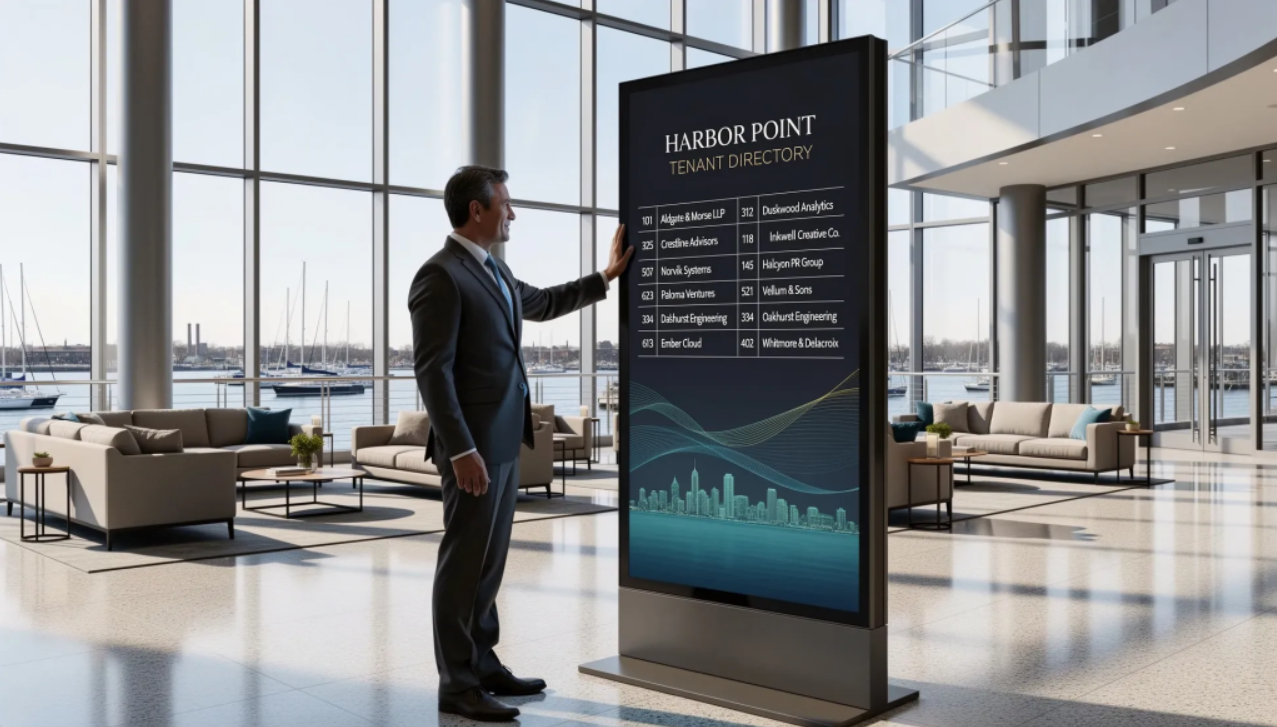
It's worth being specific about what modern building directory and wayfinding technology delivers in a mixed-use environment at the Wanamaker's scale. Audience-segmented wayfinding. Rather than one universal directory screen, Navigo®-powered systems can present tailored interfaces based on visitor intent. A touchscreen at the retail entrance surfaces a different starting experience than one at the residential lobby — even if both are running on the same platform and managed from the same content management system. Multi-entrance coordination. With entry points on both the north and south sides of the building, consistent wayfinding across all lobby locations is essential. A visitor who enters from one side and needs to reach a tenant on a different wing shouldn't have to figure that out by wandering — they should be guided there immediately and confidently. Real-time tenant directory management. In a multi-tenant retail environment where businesses open, close, and evolve, static directories become outdated almost immediately. Cloud-based platforms like Navigo® allow property managers to update tenant listings, floor assignments, hours of operation, and wayfinding routes in real time — from any device, without requiring physical hardware changes at each screen location. Visitor management and check-in workflows. For the office floors, where guests arrive for scheduled meetings and require host notification, an integrated visitor management system turns the lobby from a passive space into an active part of the building's operations. Guests can check in, notify their host, receive a badge, and receive floor guidance — all from a single touchpoint. Branded lobby experience. For a building with the Wanamaker's architectural legacy and cultural significance, the lobby experience should reflect the property's prestige. Digital directories can be custom-designed to match the building's aesthetic and brand identity, presenting tenants, amenities, and wayfinding in a way that elevates rather than interrupts the space.
The Strategic Case for Building Infrastructure Investment at RepositioningThere is a window in every major repositioning project — between the announcement and the opening — where the decisions that shape long-term tenant experience get made. Some of those decisions are architectural. Some are operational. And some, increasingly, are technological. The Wanamaker's complexity — its scale, its mixed uses, its multiple audiences, its prominent Center City location — makes it an ideal case study for what intentional lobby infrastructure investment looks like. But the logic applies across every mixed-use repositioning happening in Philadelphia right now: the buildings that design the visitor and tenant experience thoughtfully, from day one, are the buildings that perform best in a competitive leasing market. For developers and property managers planning major repositioning projects in Philadelphia and across the Mid-Atlantic region, Interactive Touchscreen Solutions, Inc. offers the technology platform, the implementation expertise, and the strategic perspective to ensure that your building's lobby experience matches the ambition of the development itself. Navigo® powers digital building directories, interactive wayfinding, visitor management systems, and integrated lobby technology for commercial, residential, and mixed-use properties across the United States and Canada. Our team has worked with some of the most prominent property owners and managers in the country — including CBRE, Jones Lang LaSalle, BioMed Realty, and CapRidge Partners — to create lobby environments that are as operationally efficient as they are impressive to experience.
Ready to Elevate Your Building's Lobby Experience?If you are planning a mixed-use repositioning, an office-to-residential conversion, or a new development in the Philadelphia region — or anywhere in the US — we would welcome the conversation. The buildings shaping Philadelphia's next chapter deserve lobby infrastructure that rises to the moment. Let's build it together.
Interactive Touchscreen Solutions, Inc. | Powered by Navigo® 📞 800-652-4830 🌐 www.itouchinc.com/contact-us
FAQsWhat is the Wanamaker Building redevelopment, and why does it matter for building technology? The Wanamaker Building in Center City Philadelphia is being converted by developer TF Cornerstone from a former Macy's department store into a 1.4-million-square-foot mixed-use property featuring 621 residential apartments, office space on floors four and five, and multi-tenant retail across the first three floors. With four separate building entrances and multiple distinct tenant populations arriving simultaneously, the property represents one of the most operationally complex lobby environments in Philadelphia — and an exceptional opportunity to implement intelligent, audience-aware building directory and wayfinding technology from the ground up. Why can't a building like the Wanamaker rely on a traditional static directory? A static directory presents the same information to every visitor, regardless of who they are or why they came. In a building serving residents, office tenants, retail visitors, and delivery personnel — each arriving through different entrances with different destinations — a one-size-fits-all approach creates friction at exactly the moment first impressions are being formed. Digital building directory systems powered by Navigo® segment the visitor experience by user type and entry point, presenting each audience with the information most relevant to them immediately upon arrival. What does "audience-segmented wayfinding" mean in practice? It means the directory system recognizes context and tailors the experience accordingly. A touchscreen positioned at the residential lobby entrance can prioritize elevator access, package room locations, and amenity wayfinding. A screen at the office entry can lead with floor directories and guest check-in workflows. A retail-facing display can surface tenant listings, hours of operation, and category browsing. All of these experiences can run on the same Navigo® platform and be managed from a single cloud-based content management system — without requiring separate hardware infrastructure for each use case. How does Navigo® handle a building with multiple entrance points? Navigo® is designed for multi-location, multi-entrance environments. Screens deployed at each entry point can be individually configured to reflect the experience appropriate to that entrance, while all content — tenant listings, wayfinding routes, operational updates — is managed centrally. When a tenant moves floors or a retailer updates its hours, the change is made once and reflected across every screen in the building in real time. What role does visitor management play in a mixed-use building like the Wanamaker? For the office floors specifically, visitor management is a critical operational layer. When a guest arrives for a scheduled meeting, a Navigo®-powered visitor management system allows them to check in independently, notifies the host automatically, generates a visitor badge if required, and provides floor-specific wayfinding to the correct suite — all from a single lobby touchpoint. This reduces front-desk dependency, creates a more professional arrival experience, and gives property managers a complete record of building access activity. When is the right time in a repositioning project to plan for digital directory and wayfinding infrastructure? The earlier, the better. The most effective implementations happen when digital wayfinding and lobby technology are considered during the design and construction phase — not added after tenants move in and navigation issues surface. For a project like the Wanamaker, where construction is expected to begin in early 2026, the planning window is open right now. Building the infrastructure before opening allows developers to launch with a complete, polished lobby experience that immediately reflects the property's quality and intent. What kinds of buildings and property types does ITS, Inc. serve? Interactive Touchscreen Solutions, Inc. serves commercial office properties, mixed-use developments, residential and multifamily buildings, healthcare facilities, government and civic buildings, retail environments, and educational campuses across the United States and Canada. Navigo® has been deployed by leading property owners and managers including CBRE, Jones Lang LaSalle, BioMed Realty, and CapRidge Partners.
Contact us today to learn more about Navigo® for your property.  |

7150 Columbia Gateway Drive, Suite L, Columbia, MD 21046
112 West 34th Street, 18th floor, Room 18025 New York, NY 10001
Proud Member

7150 Columbia Gateway Drive, Suite L
Columbia, MD 21046
112 West 34th Street, 18-025
New York, NY 10001
