

Headquarters
7150 Columbia Gateway Drive, Suite L, Columbia, MD 21046
New York Location
112 West 34th Street, 18th floor, Room 18025 New York, NY 10001
Proud Member


Navigating the PNW: How Interactive Wayfinding Technology Is Transforming the Passenger Experience at Sea-Tac and Portland International4 minute read | Updated June 19, 2026
The Pacific Northwest is moving. Sea-Tac International Airport — the 8th busiest airport in the United States by passenger volume — is in the midst of one of the most significant capital expansion programs in its history. Portland International Airport is completing a landmark terminal renovation that has drawn international attention for its design ambition and operational vision. Both airports are investing billions of dollars in physical infrastructure to meet the demands of a region whose population, tourism economy, and global connectivity continue to grow at an exceptional pace. But physical infrastructure alone doesn't create a great airport experience. Terminals can be architecturally stunning, concourses can be newly built, and gate counts can double — and passengers can still find themselves confused, frustrated, and late. Because the experience of moving through an airport is fundamentally an information problem. Passengers need to know where they are, where they need to go, how long it will take to get there, what has changed since they last checked their phone, and how to navigate a facility that may be entirely unfamiliar to them — often while managing luggage, children, jet lag, or a tight connection. That information problem is precisely what interactive wayfinding technology is designed to solve. And as Sea-Tac and PDX continue their expansions, the airports, municipal planners, and transit operators who are thinking strategically about the passenger information environment are finding that large-format interactive touch screen systems aren't a supplementary feature of the modern terminal. They're foundational infrastructure.
The Scale of What's Being BuiltTo appreciate the wayfinding challenge, it helps to understand the scale of what's currently underway in the Pacific Northwest's two major aviation hubs. Seattle-Tacoma International Airport served approximately 50.2 million passengers in 2023, a figure that has recovered strongly from pandemic lows and continues to trend upward. The airport's New Consolidated Rental Car Facility, the ongoing International Arrivals Facility expansion, and the long-planned North Satellite modernization represent a multi-billion dollar transformation of the airport's physical footprint. New concourses, new transit connections, new security checkpoints, and new retail and dining configurations are being introduced across a facility that millions of passengers are navigating simultaneously — many of them for the first time.¹ Portland International Airport is completing a $2 billion terminal renovation — the largest in the airport's history — that is adding significant new gate capacity, reconfiguring the terminal's core circulation, and introducing a dramatic new roof structure that has already become one of the most discussed airport design projects in North America. PDX served approximately 19.5 million passengers in 2023, with projections pointing to significant continued growth as the region's population expands and international routes continue to develop.² In both cases, the expansion is happening at facilities that passengers are already navigating in large numbers — which means the wayfinding challenge is not theoretical. It is live, daily, and consequential.
Why Traditional Wayfinding Falls Short in an Expanding AirportStatic signage has served airports for decades, and it remains an important component of any well-designed terminal environment. But static signage has fundamental limitations that become more acute as airports grow in size, complexity, and operational dynamism. It cannot reflect real-time change. A gate reassignment, a terminal transfer, a security checkpoint closure, a new concession opening — none of these can be communicated through a sign that was fabricated and installed months before the change occurred. In a large, active airport, the gap between what static signage says and what is actually happening at any given moment can be significant. It cannot adapt to the individual. A static sign addresses everyone, which means it effectively addresses no one in particular. A passenger connecting from an international flight with 45 minutes to their next gate has profoundly different wayfinding needs than a leisure traveler with three hours to explore the terminal. Static signage cannot distinguish between them, let alone serve them differently. It cannot bridge language barriers. Sea-Tac serves passengers from across the Asia-Pacific, Latin America, Europe, and beyond. PDX's international terminal handles a growing roster of long-haul routes. The linguistic diversity of these airports' passenger populations far exceeds what any practical array of static, multi-language signage can address. It cannot scale gracefully with physical expansion. Every time a terminal is reconfigured, a new concourse opens, or a gate numbering system changes, static signage must be physically replaced across potentially hundreds of locations — a process that is expensive, time-consuming, and frequently results in transitional periods where signage is outdated, inconsistent, or missing entirely. Interactive touch screen wayfinding systems address every one of these limitations — and do so in a way that enhances rather than clutters the terminal environment. Large-Format Interactive Maps: The Anchor of the Modern TerminalThe centerpiece of an effective airport wayfinding system is the large-format interactive map terminal — a high-resolution, touch-enabled display that gives passengers a dynamic, real-time view of the facility and an intuitive interface for navigating it. At their most capable, these systems function as a personal airport concierge. A passenger approaching a large-format terminal at Sea-Tac's international arrivals hall can immediately orient themselves within the facility, search for their connecting gate by flight number, receive a step-by-step walking route that accounts for current security wait times, identify the nearest restroom, lounge, or dining option along their path, and check the real-time status of their next flight — all within a 60-second interaction. The impact on passenger stress and confidence is immediate and measurable. Airports Council International (ACI) research has consistently found that wayfinding clarity is among the top three drivers of overall passenger satisfaction scores, alongside security wait times and food and beverage quality.³ Passengers who feel oriented and informed consistently rate their airport experience higher — regardless of delays or other factors outside the airport's control. For airport operators and municipal planners, that passenger satisfaction data matters for reasons beyond guest experience. ACI's Airport Service Quality (ASQ) rankings directly influence an airport's competitive positioning for international routes, airline partnerships, and tourism authority relationships. Airports that score well on passenger experience metrics attract investment. Those that don't face reputational and commercial consequences.
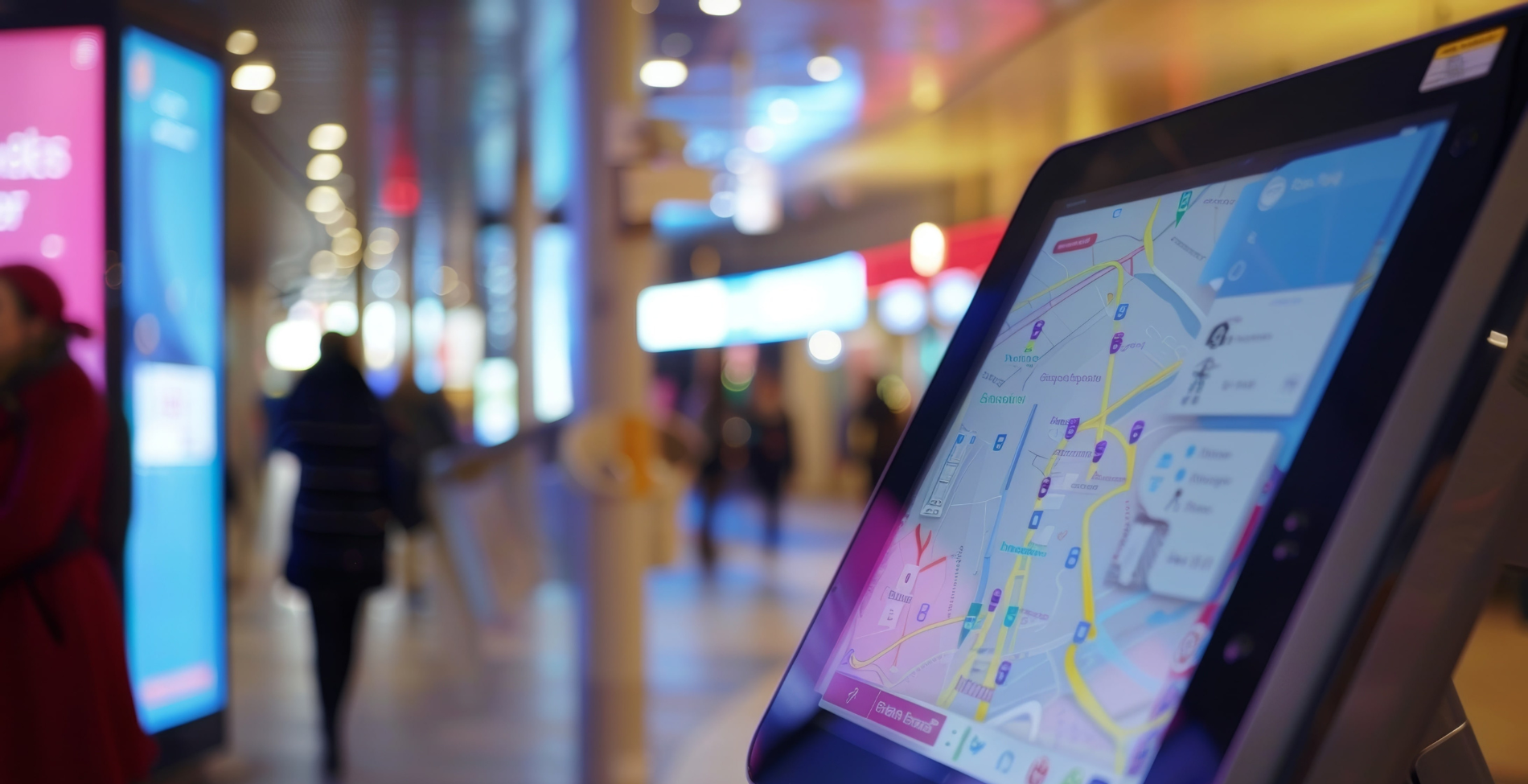
Real-Time Flight Updates: Connecting the Terminal to the OperationOne of the most powerful capabilities of modern interactive wayfinding terminals is their ability to integrate directly with an airport's operational data feeds — pulling real-time flight status information, gate assignments, security wait times, and terminal alerts directly into the passenger-facing interface. This integration transforms the wayfinding terminal from a static map tool into a live operational dashboard that passengers can access at any point in their journey. A traveler who has just cleared security at PDX's renovated central checkpoint can approach a wayfinding terminal, enter their flight number, and receive not just a route to their gate but a real-time confirmation that the gate assignment hasn't changed, that the flight is on time, and that they have sufficient time to stop at a restaurant along the route the system recommends. For connecting passengers navigating Sea-Tac's complex multi-concourse layout — where connections between the N, S, A, B, C, and D gates can involve significant transit distances and, for some connections, a Satellite Transit System ride — real-time operational data integration is particularly valuable. A passenger with a tight connection who knows, from an interactive terminal, exactly which route to take and exactly how much time they have is a passenger who makes their flight. That outcome matters to the airline, to the airport's on-time performance metrics, and above all to the traveler. SITA's 2023 Air Transport IT Insights report found that airports with integrated real-time passenger information systems saw a measurable reduction in missed connections and a significant decrease in calls and inquiries to airport information desks — reducing operational burden while improving the passenger experience simultaneously.⁴
Multilingual Accessibility: Serving the Full Diversity of Pacific Northwest TravelersThe Pacific Northwest's airports serve one of the most linguistically diverse passenger populations in North America. Sea-Tac is a primary gateway for travelers from East and Southeast Asia, with significant volumes of passengers whose primary languages include Mandarin, Cantonese, Japanese, Korean, Tagalog, and Vietnamese — alongside Spanish, Russian, and a wide range of other languages reflecting the region's immigrant communities and international tourism flows. Static English-primary signage, supplemented by occasional secondary language translations, is not an adequate response to that diversity. Interactive wayfinding terminals are. Modern airport wayfinding systems support fully configurable multilingual interfaces — allowing passengers to select their preferred language from the terminal's opening screen and receive all wayfinding content, flight information, facility descriptions, and navigation instructions in that language. At a well-implemented terminal, a Japanese-speaking passenger arriving at Sea-Tac for the first time and a Spanish-speaking traveler connecting through PDX both receive a wayfinding experience that is fully native to their language — with no degradation in information depth or navigational accuracy. The Americans with Disabilities Act (ADA) and broader accessibility standards also inform the design of modern wayfinding terminals. Systems deployed in public transit infrastructure must meet requirements for visual accessibility, including adjustable text sizing, high-contrast display modes, and audio output capabilities for visually impaired passengers. Leading interactive wayfinding platforms build these capabilities into the core system architecture rather than treating them as add-ons — ensuring that the full passenger population, including those with disabilities, receives the benefit of the technology. For airport operators navigating the complex regulatory and public accountability environment of a major public transit hub, deploying technology that meets or exceeds accessibility standards is not just a compliance consideration. It's a statement of institutional values — and an increasingly visible one, as passenger advocacy groups and accessibility auditors pay closer attention to the technology environments of major airports.
Contactless Ticketing and Check-In Kiosks: The Full Self-Service EcosystemInteractive wayfinding terminals are the most visible component of a modern airport's self-service technology ecosystem, but they function most effectively as part of a broader, integrated infrastructure that includes contactless ticketing kiosks, self-service bag drop systems, and automated check-in terminals. The post-pandemic airport environment has permanently elevated passenger appetite for contactless, self-directed interactions. SITA's Passenger IT Insights 2023 found that 73% of passengers now prefer self-service options for check-in and boarding pass issuance, and that preference is highest among frequent travelers — the demographic that drives the most revenue for airports and airlines.⁵ For Sea-Tac and PDX, both of which are expanding their gate counts and passenger capacity, the ability to process higher volumes of passengers through check-in and ticketing without proportional increases in staffing is an operational imperative. Contactless kiosk systems — designed for intuitive, rapid interaction and integrated with airline reservation systems, TSA PreCheck and Global Entry databases, and airport operational platforms — make that possible. The design of these kiosks matters as much as their functionality. In the context of PDX's landmark renovation — which has set a new benchmark for airport design in North America — and Sea-Tac's ongoing modernization, the physical and visual design of self-service terminals must meet a high aesthetic standard. Kiosks that look dated, feel fragile, or clash with the terminal's design language undermine the overall experience. The best implementations treat the kiosk as a piece of the terminal's design, not an afterthought installed around it.
The Data Layer: How Smart Wayfinding Infrastructure Generates Operational IntelligenceOne of the less visible but increasingly valuable benefits of deploying interactive wayfinding and self-service kiosk infrastructure in an airport environment is the operational data these systems generate. Every interaction with a wayfinding terminal — every search query, every route request, every language selection, every point of abandonment in an interaction flow — is a data point about how passengers are experiencing the facility. Aggregated and analyzed, this data reveals where passengers are getting lost, which destinations are most frequently searched, which terminal areas are generating the most wayfinding confusion, and where the gap between the facility's physical design and passengers' intuitive navigation behavior is widest. For airport operators and facility planners, this intelligence is genuinely transformative. Instead of relying on complaint data, staff observations, or periodic passenger surveys to identify wayfinding deficiencies, operators have access to a continuous, high-resolution picture of how passengers are actually moving through the facility and where the friction points are. That intelligence can inform signage placement decisions, gate assignment strategies, concession location planning, and capital investment priorities in ways that static data sources simply cannot. Deloitte's 2023 Future of Mobility report identified real-time operational data integration as one of the top five infrastructure investments driving measurable efficiency gains in major transit hubs globally.⁶ For Sea-Tac and PDX — both of which are making multi-billion dollar infrastructure investments and operating under significant public accountability — the ability to optimize those investments using live passenger behavior data is a compelling addition to the case for interactive wayfinding technology.
What Municipal Planners and Transit Operators Should KnowFor the municipal planners, transit authority executives, and airport operations leadership responsible for Sea-Tac and PDX, the decision to invest in interactive wayfinding infrastructure is increasingly not a question of whether — it's a question of how, at what scale, and with which implementation partner. A few principles consistently characterize successful deployments at major transit hubs. Integration is everything. A wayfinding terminal that operates in isolation — displaying static maps without connection to real-time flight data, facility management systems, or operational alerts — delivers a fraction of the value of a fully integrated system. The investment in integration is always justified by the operational and passenger experience outcomes it enables. Scalability must be designed in from the start. Both Sea-Tac and PDX are mid-expansion facilities that will look meaningfully different in five years than they do today. Wayfinding infrastructure must be designed with that evolution in mind — using platforms and hardware that can be updated, reconfigured, and expanded without requiring a complete system replacement every time the physical facility changes. The passenger experience should drive every design decision. Technology that is technically sophisticated but difficult to use, visually cluttered, or poorly placed in the terminal flow fails regardless of its underlying capability. The best airport wayfinding deployments are those where the technology has been designed from the passenger's perspective — where the interface is intuitive enough that a first-time visitor can orient themselves within seconds, and the physical placement of terminals anticipates where passengers naturally pause and seek orientation. Accessibility cannot be an afterthought. For a public transit facility serving millions of passengers with widely varying abilities, languages, and technology comfort levels, accessibility must be built into the system architecture from the beginning — not retrofitted after the fact.
ITS, Inc.: A Strategic Partner for Complex Transit EnvironmentsAt ITS, Inc., we understand that the wayfinding challenge in a major airport is not a single-product problem. It requires a systems-level approach — one that integrates large-format interactive maps, real-time operational data feeds, multilingual interfaces, accessibility compliance, contactless ticketing infrastructure, and the physical design sensibility to make all of it feel cohesive and purposeful within a premium transit environment. Our experience spans healthcare systems, commercial real estate portfolios, retail environments, and institutional facilities — contexts that share with airports a common demand for technology that performs flawlessly under high traffic, serves a diverse and often unfamiliar user population, and integrates seamlessly into complex operational ecosystems. We bring that depth of experience to every transit and aviation engagement, and we partner with our clients not just through installation but through the ongoing optimization that turns a good deployment into a great one. The Pacific Northwest is building for the future. ITS, Inc. is here to make sure every passenger can find their way through it.
Let's Build a Smarter Terminal TogetherITS, Inc. partners with airport operators, municipal planners, transit authorities, and facility managers to design and deploy interactive wayfinding and self-service kiosk solutions that transform the passenger experience. From large-format interactive maps to multilingual accessibility interfaces and real-time operational data integration, we bring the full spectrum of interactive touch screen capability to the environments where it matters most.
Sources
Frequently Asked QuestionsWhat makes interactive wayfinding terminals more effective than traditional airport signage? Interactive wayfinding terminals offer capabilities that static signage structurally cannot: real-time information that reflects current gate assignments and flight status, personalized routing based on a specific passenger's destination and time constraints, multilingual interfaces that serve the full diversity of an airport's passenger population, and accessibility features for passengers with visual or mobility impairments. They also generate operational data that helps airport teams continuously improve the passenger experience — a feedback loop that static signage cannot provide. How do interactive wayfinding systems integrate with airport operational data? Modern airport wayfinding platforms are designed to connect with an airport's existing operational data infrastructure through standard APIs and data feeds. This includes airline reservation and flight status systems, gate management platforms, security checkpoint wait time monitoring, and facility management systems. The integration allows the wayfinding terminal to display real-time, accurate information — including gate changes, delay notifications, and operational alerts — without requiring manual updates from airport staff. Can interactive wayfinding terminals support multiple languages simultaneously? Yes. Leading interactive wayfinding systems support fully configurable multilingual interfaces, allowing passengers to select their preferred language from the terminal's opening screen. All wayfinding content, flight information, and navigation instructions are then delivered in the selected language with no reduction in depth or accuracy. Systems can typically support dozens of languages simultaneously, with content managed centrally and updated in real time. What accessibility standards do airport interactive kiosks need to meet? Airport interactive kiosks deployed in public transit facilities must meet ADA requirements and applicable accessibility standards, which typically include adjustable text sizing, high-contrast display modes, audio output for visually impaired passengers, appropriate mounting heights for wheelchair users, and tactile or auditory feedback for key interactions. The specific requirements vary by jurisdiction and facility type, and ITS, Inc. works closely with airport operators and compliance teams to ensure every deployment meets or exceeds applicable standards. How does contactless kiosk technology reduce operational burden for airport staff? By enabling passengers to complete check-in, boarding pass issuance, and basic wayfinding inquiries through self-service terminals, contactless kiosk technology significantly reduces the volume of routine interactions that would otherwise require staff assistance. This frees airport personnel to focus on complex passenger needs, exceptional service situations, and operational priorities — improving both staff efficiency and the quality of human interactions that passengers do have. SITA research has documented measurable reductions in information desk inquiries at airports with well-deployed self-service wayfinding infrastructure. What is the typical implementation timeline for an airport wayfinding system? Implementation timelines vary significantly based on the scale of the deployment, the complexity of system integrations required, and the physical environment of the terminal. For a phased deployment at a major airport — beginning with high-traffic wayfinding anchor points and expanding across the terminal — a realistic timeline from initial discovery through full deployment is typically 6–18 months. ITS, Inc. works with airport operators and municipal planners to develop phased deployment plans that deliver early operational value while building toward a comprehensive, fully integrated system. Why should airport operators choose ITS, Inc. as their wayfinding technology partner? ITS, Inc. brings a combination of technical depth, implementation experience across complex high-traffic environments, and a strategic partnership approach that extends well beyond the initial deployment. We've worked with major institutional clients — including large healthcare systems and commercial real estate portfolios — that share with airports a demand for technology that performs reliably at scale, serves diverse user populations, and integrates with complex operational ecosystems. We don't deliver hardware and move on. We stay engaged through optimization, expansion, and the ongoing evolution of the passenger experience our clients are building.
Contact us today to learn more about Navigo® for your property.  |

7150 Columbia Gateway Drive, Suite L, Columbia, MD 21046
112 West 34th Street, 18th floor, Room 18025 New York, NY 10001
Proud Member

7150 Columbia Gateway Drive, Suite L
Columbia, MD 21046
112 West 34th Street, 18-025
New York, NY 10001
